
Top 10 Architecture Companies in Florida Shaping Homes, Cities and Sustainable Design

Florida is one of the most demanding places in the United States to practice architecture. Heat, salt air, hurricanes, flood risk, strict codes, tourism pressure, historic districts, and fast population growth all meet in the same project brief. The best firms here do more than make buildings look good. They solve for shade, resilience, density, public life, and the strange beauty of living between ocean, wetland, and city.
This guide to the Top 10 architecture companies in Florida. highlights firms with strong design identities, visible bodies of work, and a meaningful role in shaping how the state builds. Some are Florida-born studios with deep local roots. Others are national or global firms with major Florida offices and projects. Together, they show the range of architecture happening across Miami, Sarasota, Tampa Bay, Orlando, Palm Beach, and beyond.
How this list was selected
This is not a revenue ranking. It is a curated look at firms with strong Florida relevance, public visibility, design quality, and influence on the built environment.
The selection weighs:
Design identity Clear architectural language, not generic production work.
Project range Residential, commercial, civic, hospitality, education, planning, or sustainable design.
Florida impact Work that responds to climate, urban growth, preservation, coastal living, or public space.
Recognition and staying power Firms with long-term influence, widely known projects, or a distinct voice in the profession.

1. Arquitectonica
Arquitectonica is one of the most recognizable architecture firms to emerge from Florida. Founded in Miami, the firm helped define the city’s late 20th-century architectural identity with bold geometry, bright color, strong silhouettes, and a willingness to make buildings part of the city’s public image.
Its best-known Miami works include the Atlantis Condominium, a building that became a shorthand for Miami’s postmodern moment, and major mixed-use work such as Brickell City Centre. The firm has also worked on civic, cultural, residential, hospitality, retail, and campus projects around the world.
Arquitectonica’s design style often favors strong massing, graphic forms, and urban presence. In Florida, that approach suits dense neighborhoods such as Brickell, Downtown Miami, and Miami Beach, where buildings must address skyline, street, climate, and market pressure at once.
Its community contribution is tied to urban transformation. Arquitectonica has played a major role in showing how dense mixed-use development can reshape walkable districts in a car-heavy region. Its best projects help connect retail, housing, transit, shaded circulation, and public space.
Areas of expertise
High-rise residential
Mixed-use development
Commercial architecture
Hospitality and retail
Urban design
2. Zyscovich
Zyscovich is a Miami-based firm known for architecture, planning, and urban design across Florida. While some firms build a reputation through single icons, Zyscovich has shaped neighborhoods, campuses, transit-related projects, schools, and civic places.
The firm is often associated with large-scale planning and public-sector work. Its portfolio includes education projects, transportation facilities, master planning, mixed-use districts, and community-centered development. Zyscovich’s work on areas such as Midtown Miami reflects a long interest in urban repair, compact growth, and the creation of more walkable districts.
The firm’s design style is pragmatic and urban. It tends to focus less on stand-alone spectacle and more on how buildings fit into streets, campuses, and civic systems. That makes its work especially relevant in Florida, where cities are trying to shift from isolated development patterns toward stronger public realms.
Its community contribution comes through schools, neighborhood planning, and civic infrastructure. These are the project types that shape daily life, even when they do not always get the same attention as luxury towers.
Areas of expertise
Master planning
Education design
Civic architecture
Transportation-related projects
Mixed-use development
3. Oppenheim Architecture
Oppenheim Architecture, based in Miami, is known for a refined, atmospheric version of modernism. The firm often works with stone, concrete, wood, water, shadow, and landscape in a way that makes architecture feel grounded rather than loud.
In Miami, the firm gained attention through projects such as Ten Museum Park, along with private residences and hospitality work. Its portfolio extends well beyond Florida, but the firm’s design language fits many Florida conditions: strong sun, indoor-outdoor living, privacy, and the need for durable materials.
Oppenheim’s work often feels quiet, low-slung, and tactile, even when the program is large. Rather than relying on ornament, the firm uses mass, proportion, courtyards, screens, and material depth. For residential and resort projects, that approach creates spaces that feel protected from heat while still connected to air, water, and vegetation.
The firm’s contribution to local design culture is its commitment to restraint in a market that often rewards flash. It has helped expand the image of Miami architecture beyond color and spectacle toward a more elemental, place-based modernism.
Areas of expertise
High-end residential
Hospitality design
Resort architecture
Mixed-use projects
Contextual modernism

4. Kobi Karp Architecture & Interior Design
Kobi Karp Architecture & Interior Design is a Miami firm with a large footprint in hospitality, multifamily residential, retail, and mixed-use projects. The firm has worked on hotels, condominium towers, historic renovations, and luxury developments throughout South Florida.
Its project list includes work connected to major Miami Beach and Surfside properties, including hospitality and residential redevelopment in architecturally sensitive coastal areas. The firm is often involved where architecture, interiors, preservation, zoning, and development economics overlap.
Kobi Karp’s design style varies by project type. Some buildings lean toward contemporary glass and clean-lined luxury. Others work within Mediterranean Revival, Art Deco, or mid-century contexts. That flexibility is useful in Miami Beach, where new work often has to negotiate historic character and high market expectations.
The firm’s local contribution is especially visible in adaptive reuse and hospitality. South Florida’s hotel stock includes many older structures, and thoughtful redevelopment can keep cultural memory in place while meeting current code, accessibility, and performance needs.
Areas of expertise
Hospitality architecture
Multifamily residential
Historic renovation
Interior design
Mixed-use development
5. René Gonzalez Architects
René Gonzalez Architects brings a highly site-specific approach to Miami architecture. The firm is known for work that responds to water, light, vegetation, art, and the sensory character of place. Its projects often feel carefully tuned rather than broadly styled.
Notable work includes GLASS Miami Beach, a slender residential tower, and the Alchemist retail space at 1111 Lincoln Road, where the architecture engages an existing parking structure in a memorable way. The firm has also designed private homes, galleries, interiors, and cultural spaces.
René Gonzalez’s design style often blends minimal forms with warm materials, lush planting, reflection, and filtered light. In the best projects, architecture becomes a frame for climate and atmosphere. That matters in Florida, where glare, humidity, shade, and breeze are not background conditions. They are central design materials.
The firm’s contribution to the local community lies in raising the bar for sensory and environmental awareness. Its work shows that luxury and restraint can coexist, and that small details can produce a deep connection to site.
Areas of expertise
Custom residential design
Boutique residential towers
Retail and gallery spaces
Interior architecture
Site-responsive modernism
6. Strang Design
Strang Design has offices in Miami and Sarasota and is strongly associated with environmental modernism. The firm’s work often draws from the legacy of the Sarasota School of Architecture, with deep overhangs, cross-ventilation, shaded glass, indoor-outdoor living, and a serious response to climate.
Strang is best known for contemporary residential work, especially custom homes in coastal and subtropical settings. Its projects often feature clean horizontal lines, warm wood, limestone, concrete, water, and strong connections to gardens or courtyards. The firm also works in hospitality, interiors, and selected commercial projects.
Its notable work includes many award-winning residences across South Florida and the Gulf Coast. Rather than relying on a single signature icon, Strang has built influence through a consistent body of climate-aware houses.
The community contribution is architectural education by example. The firm keeps Florida’s regional modernist lineage alive while updating it for current expectations around energy use, resilience, craft, and comfort. Its houses show that sustainability can be beautiful, practical, and deeply tied to local building traditions.
Areas of expertise
Custom residential architecture
Sustainable design
Tropical modernism
Interior design
Hospitality projects
7. HOK
HOK is a global architecture, planning, and design firm with a significant presence in Florida. Its work in the state includes civic, cultural, aviation, science, health, and commercial projects. It brings the scale and technical depth needed for complex public and institutional buildings.
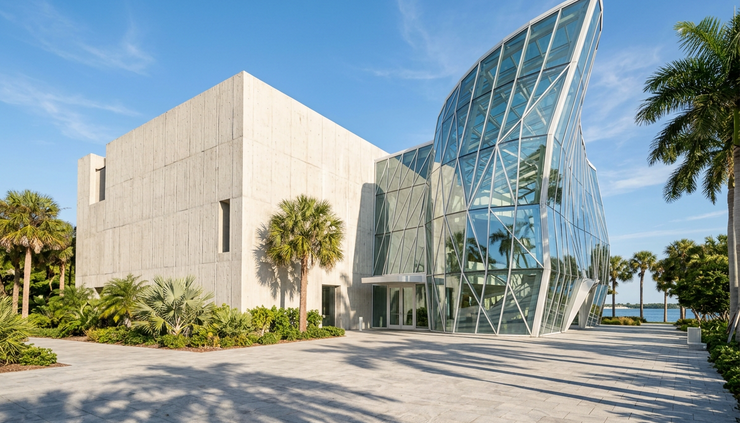
One of the firm’s most recognized Florida projects is The Dalí Museum in St. Petersburg, designed with a distinctive glass form that responds to both the art collection and hurricane-prone Gulf Coast conditions. The building pairs a protective concrete enclosure with a flowing glazed atrium, creating a memorable public space while addressing risk.
HOK’s design style changes by project, but its strongest work combines technical performance with civic presence. In Florida, that often means flood awareness, wind resistance, energy use, daylight control, and clear circulation for large public buildings.
Its community contribution shows up in projects that serve broad audiences: museums, airports, campuses, health facilities, and civic spaces. These buildings are not just destinations. They become part of the public infrastructure of daily life and tourism.
Areas of expertise
Cultural architecture
Aviation and transportation
Science and technology
Health facilities
Civic and institutional design
8. Sweet Sparkman Architecture & Interiors
Sweet Sparkman Architecture & Interiors, based in Sarasota, has built a strong reputation for civic, cultural, residential, and community-focused design. The firm works at a scale that matters deeply to local life: beach facilities, libraries, public safety buildings, cultural projects, homes, and interiors.
Its notable work includes public and coastal community projects in the Sarasota region, including beach-related facilities and civic buildings that must handle heavy use, salt air, sun exposure, and storm concerns. The firm’s projects often balance clean contemporary forms with durability and public comfort.
Sweet Sparkman’s design style is clear, warm, and regionally aware. It often uses shade, simple massing, natural materials, and strong indoor-outdoor relationships. The work tends to feel approachable rather than precious, which is valuable for public buildings that must welcome residents and visitors every day.
The firm’s contribution to the community is direct. It designs the kinds of places people use repeatedly over years, from neighborhood facilities to cultural spaces. In a region with a rich architectural history, Sweet Sparkman continues the Sarasota tradition without copying it.
Areas of expertise
Civic architecture
Cultural spaces
Coastal community facilities
Residential design
Interior architecture
9. Guy Peterson Office for Architecture
Guy Peterson Office for Architecture is a Sarasota-based studio with a strong connection to Florida modernism. Peterson’s work is often discussed in relation to the Sarasota School, though his projects are contemporary rather than nostalgic.
The firm is known for refined residential architecture, especially houses that use simple geometry, careful proportion, shade, and regional materials. Its work includes private homes and smaller cultural or community projects in the Sarasota area.
The design style is disciplined and architectural in the classic sense: planes, walls, voids, light, and sequence. Many projects favor white surfaces, strong horizontal lines, framed views, and a calm relationship between interior and exterior space. This makes the work especially relevant in Florida, where modern form must still manage heat, glare, rain, and privacy.
The firm’s local contribution is cultural continuity. Sarasota has one of the richest modernist traditions in the country, and Peterson’s work keeps that conversation active. It gives architects and clients a model for quiet rigor in a market that can easily drift toward excess.
Areas of expertise
Custom residential architecture
Regional modernism
Small-scale cultural projects
Climate-responsive design
Architectural detailing
10. Brooks + Scarpa
Brooks + Scarpa has roots in Florida and a national reputation for sustainable, socially aware architecture. The firm is known for affordable housing, civic buildings, residential projects, and design research that treats environmental performance as a core architectural issue.
Its work outside Florida is widely published, but the firm’s Fort Lauderdale origins and continued Florida connections matter. South Florida’s climate, housing pressure, and environmental risks align closely with the firm’s interests in resource use, livability, and design quality for a wide range of users.
Brooks + Scarpa’s design style is inventive without feeling arbitrary. Projects often use screens, layered facades, courtyards, shading devices, and economical materials in expressive ways. The firm has shown that sustainable architecture does not have to look bland or feel like a checklist.
Its community contribution is its commitment to housing and public value. In Florida, where affordability, climate risk, and growth collide, that point of view is especially important. The firm’s body of work reminds the profession that design excellence should not be reserved only for luxury commissions.
Areas of expertise
Sustainable architecture
Affordable housing
Civic design
Residential projects
Climate-responsive envelopes

What these Florida firms reveal about the state’s architecture
Looking across the list, several themes stand out.
Climate is the real client
Good Florida architecture starts with environmental pressure. Shade, ventilation, storm resistance, humidity, corrosion, and flood risk shape the work before style enters the conversation.
That is why deep overhangs, screened outdoor rooms, resilient ground floors, shaded courtyards, and durable assemblies appear again and again. In Florida, these are not decorative gestures. They are working parts of a building.
Residential design carries serious influence
Many of Florida’s best architectural ideas show up first in houses. Custom residential work gives firms room to test courtyards, passive cooling, material restraint, water management, and indoor-outdoor living.
Those ideas often migrate into hospitality, multifamily, and civic projects. The line between a coastal house, a boutique hotel, and a small cultural building can be surprisingly productive.
Preservation and growth must coexist
Florida cities are still growing, but they also carry important architectural histories: Art Deco Miami Beach, Mediterranean Revival neighborhoods, mid-century Sarasota modernism, and postwar civic campuses.
The best firms understand that preservation is not only about freezing buildings in time. It can also mean adapting older structures, respecting scale, and keeping local identity legible as density increases.
Sustainability is moving from feature to framework
Sustainable design in Florida cannot stop at efficient systems. It has to address water, heat, material longevity, transportation, and land use. A sealed glass box with efficient equipment is rarely enough.
Firms such as Strang Design, Brooks + Scarpa, HOK, Sweet Sparkman, and others show different paths forward, from passive residential strategies to large-scale public buildings that must perform under tough conditions.
How to choose the right Florida architecture firm
The right firm depends on the project type, site, budget, and level of complexity. A custom waterfront home has different needs than a school, hotel, mixed-use tower, or museum.
For a better selection process, focus on fit rather than name recognition.
Ask these questions early:
Has the firm completed projects with similar climate and code conditions?
Does its portfolio show the level of detail your project needs?
Can the firm handle zoning, preservation, coastal, or community review issues?
Does its design style align with the desired experience of the building?
Can the team explain how the project will address heat, water, wind, and long-term maintenance?
For architects studying the Florida market, these firms also offer useful lessons. The most successful work rarely treats climate, code, and beauty as separate issues. It folds them together.
FAQ
What types of architecture firms are strongest in Florida?
Florida has strong firms in residential, hospitality, mixed-use, civic, education, and sustainable design. Coastal residential and hospitality work are especially visible, but public buildings, schools, museums, and planning projects also shape the state in major ways.
Which Florida city has the most active architecture scene?
Miami has the highest international profile, especially for towers, hospitality, retail, and mixed-use work. Sarasota has an outsized influence because of its modernist tradition. Tampa Bay, Orlando, Palm Beach, and Fort Lauderdale also have active design communities.
Are Florida architecture firms focused on sustainability?
Many are, though the approaches vary. In Florida, sustainability often means passive shade, storm resilience, flood-aware planning, durable materials, energy control, and better indoor-outdoor performance. It is as much about long-term survival as energy savings.
Do national architecture firms compete with local Florida firms?
Yes, but they often serve different roles. Large national firms are common on airports, hospitals, campuses, and major civic projects. Local and regional firms often bring deeper knowledge of neighborhoods, codes, climate patterns, and local review processes.
Need BIM support for your project?
Designing in Florida means coordinating architecture, structure and MEP under strict hurricane and flood requirements. MANSYCOM supports architects and contractors with architectural BIM services, BIM modeling and VDC and BIM coordination that catch clashes before they reach the site.
Ready to talk through your project? Contact the MANSYCOM BIM team.


